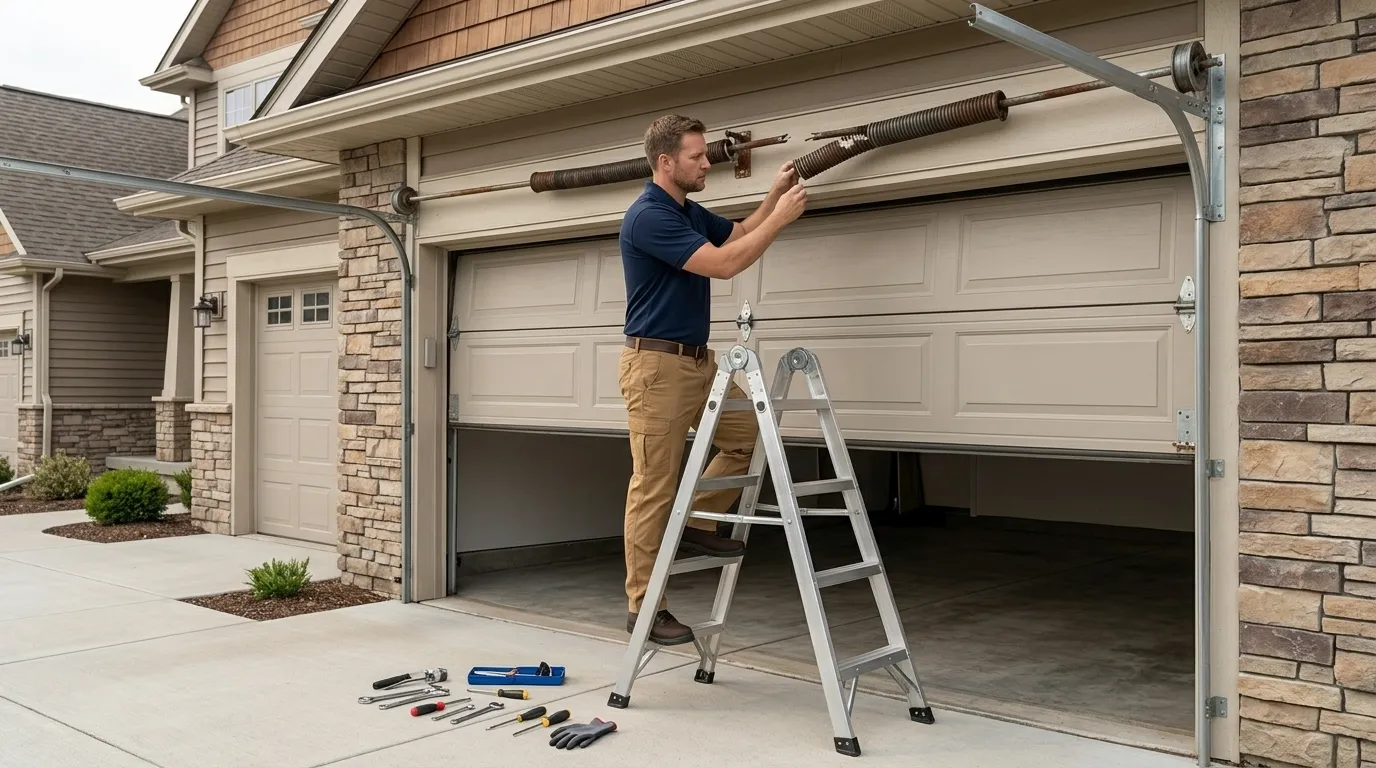
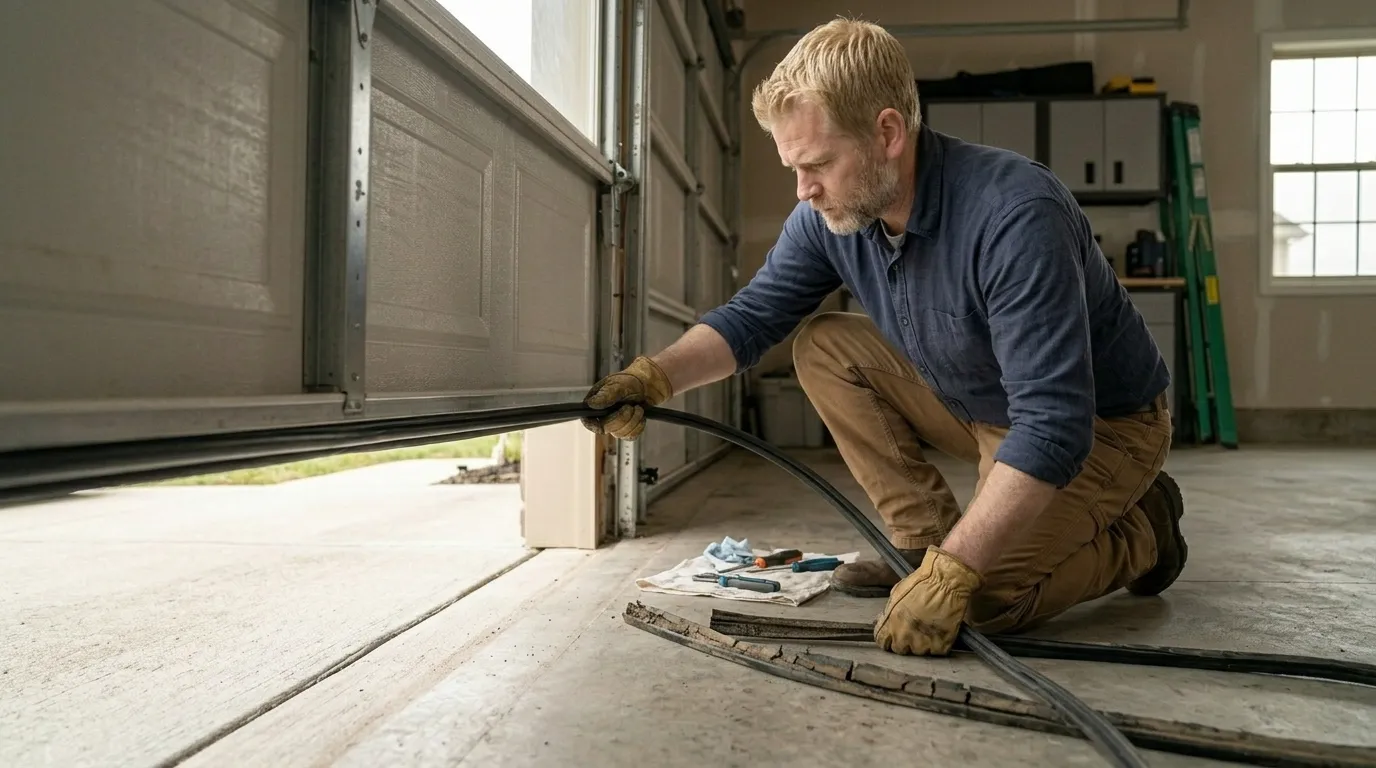
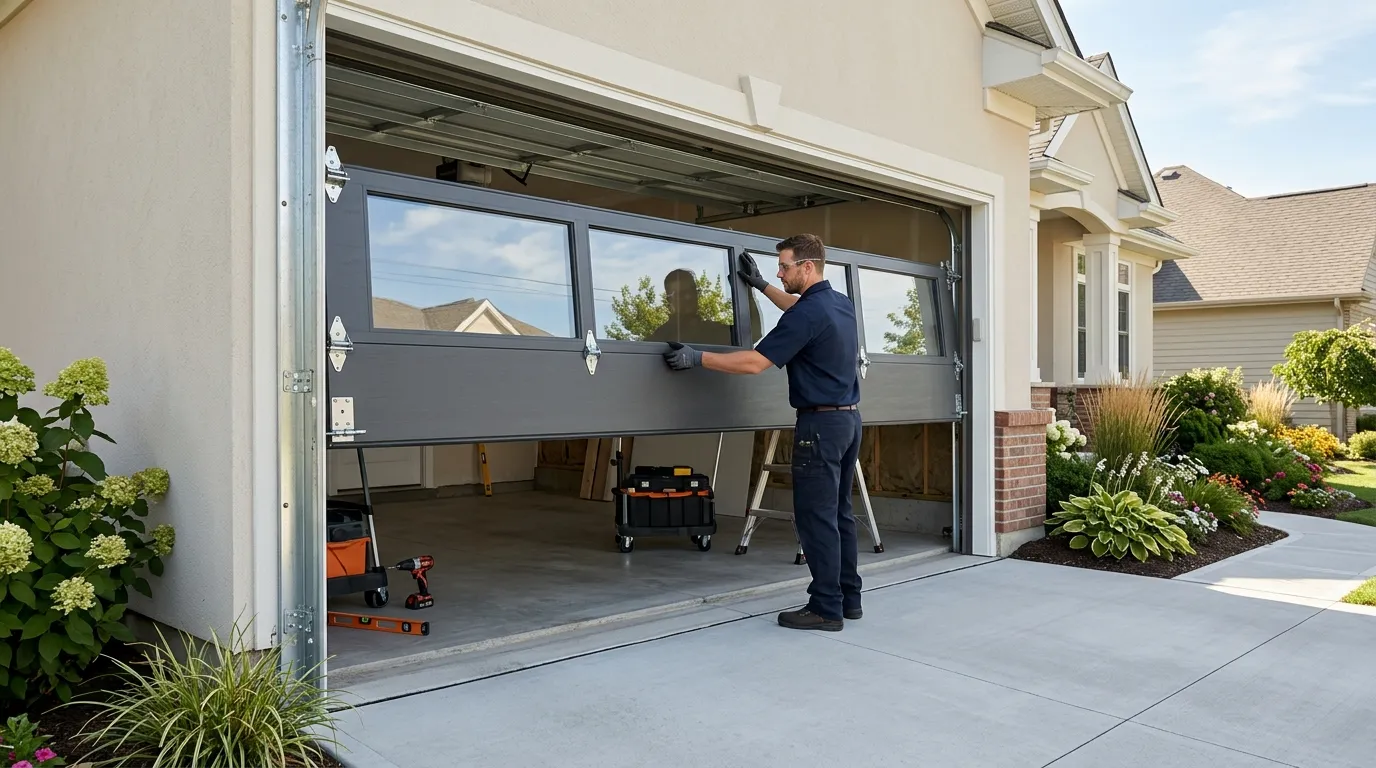
Start with the manual release cord, the red one hanging from the trolley. Pull it and the door should separate from the opener carriage and lift by hand with reasonable effort. If it doesn't move smoothly, that's spring tension trouble, not an opener problem, and no battery backup fixes that.
Next, check whether you even have a battery backup unit on the opener head. A lot of houses in this area were built between 1962 and 2001, with a heavy concentration in the 1980s and 90s, and openers from that era were replaced piecemeal over the decades - some units are recent belt-drive models with backup built in, others are the same chain-drive box that's been up there since the house was new. If you don't know which you have, look for a second small battery pack clipped near the opener motor.
Check the safety sensors at the bottom of the tracks too. These little photo-eyes are the first thing to lose alignment when a door gets bumped or a bracket loosens over the years, and a power cut is exactly when you don't want to be diagnosing a blinking light in the dark. We don't retrofit battery backup onto every opener model - some housings are too old to accept the kit, full stop.
Season by Season
Madison sits in a cold, moderate climate band, and that shapes the opener year-round more than most owners expect. Winter is the hard season: below-freezing temperatures thicken the grease in an older chain-drive unit, so the chain drags and the motor works harder right when ice storms are also most likely to knock out power. That's the worst combination - a door that needs manual release badly, on a mechanism that's stiff from the cold.
Spring brings the freeze-thaw cycle, which can shift a garage slab slightly and throw the door out of square with its tracks. It's worth running the manual release once as the weather warms, just to confirm it still moves freely after a winter of sitting still.
Summer is the easy season here - no cold-grease drag, no ice on the sensors, and it's the best time to test a battery backup unit under a real short outage rather than finding out it's dead during a January storm.
Fall is prep season. If you're going to add or replace a backup battery before winter, that's the window, before the cold sets back in.
What Is Going On
A garage door opener loses power for one of two reasons: the outage is upstream (the grid) or it's local (a tripped breaker, a loose plug). Either way, the opener stops, and what happens next depends on the mechanism and the door itself, not on how nice the remote is.
On a chain-drive unit, common in the 1980s and 90s houses that make up a big share of this area's stock, there's no battery backup unless one's been added after the fact - those units were built before backup power was standard equipment. The door sits locked to the carriage until someone pulls the manual release.
On a newer belt-drive opener, especially anything installed in the last several years, there's a decent chance a battery pack is already built in and will run the door through a handful of cycles during an outage.
The age gap matters because this area's housing runs from 1962 through 2001, median build year around 1986 - meaning original openers, once-replaced openers, and brand-new units are all still in service on the same block. There's no single answer for "what happens when the power goes out here" because it depends which decade your opener came from.
How Local Conditions Play In
Put the housing age and the climate together and you get a pattern specific to this area. Across the roughly 37,541 owner-occupied houses in the service area, a large share are running openers that predate battery backup as a standard feature, because the houses themselves went up mostly in the 1962-2001 window, with the heaviest concentration in the 80s and 90s. Cold winters mean those older units also run stiffer on the coldest days, which is exactly when outages tied to winter weather are most likely.
At a median household income of $98,943 across the roughly 87,219 households here, most owners can afford a battery backup retrofit or a belt-drive replacement with backup built in, and it's a reasonable upgrade to consider before winter rather than after a cold night with the car stuck outside. But affordability isn't the same as necessity - if your opener is old enough that a retrofit kit won't fit the housing, replacement is the honest answer, not a workaround.
We won't tell you every opener needs a battery backup. Plenty of owners go years without an outage that matters. But knowing which decade your opener is from tells you more about what happens in a power cut than anything on the box it came in.
How it works
From “it’s stuck” to “it’s fixed”
01
Tell us what’s wrong
Describe the symptom - won’t open, loud bang, opener runs but the door won’t move.
02
On-site diagnosis
A technician tests the door under power and by hand and finds what actually failed.
03
Clear, up-front plan
You get the fix that’s needed and what drives the cost - before any work starts.
04
Repaired & tested
The repair is done, the door is set true and tested, and the work area left clean.
Serving Madison, WI - tell us what your door’s doing and we’ll take it from there.
Does my garage door opener need a battery backup in Madison?
It depends on the opener's age. Openers installed before backup power was standard, common in this area's 1980s-90s housing stock, won't have one unless it's been added. In a cold climate where outages often come with winter storms, it's worth checking rather than assuming.
Why is my opener chain so stiff in winter?
Cold thickens the grease on chain-drive units, and Madison sits in a cold, moderate climate band where sub-freezing stretches are routine. The stiffness is normal wear behavior, not a sign the opener is failing, but it does make manual release harder exactly when you might need it during an outage.
Can any opener take a battery backup retrofit?
No. Some older housings, especially chain-drive units from the 1980s and 90s common in this area, aren't built to accept a backup kit. If yours can't, replacement with a newer belt-drive unit is the straightforward option rather than forcing a retrofit that won't hold.
What should I do first when the power goes out and I need the car?
Pull the manual release cord near the trolley and lift the door by hand. If it's stiff or heavy, that's a spring or track issue, not something a battery backup would have fixed anyway.
Ready to get your garage door sorted?
Tell us what it’s doing and where you are in Madison - we’ll take it from there.